If your biceps aren't growing, adding more weight to your standard dumbbell curls might not be the answer. Many home lifters repeat the same exercise every week, hoping heavier dumbbells will eventually deliver bigger arms.
The problem? Your biceps aren't just one muscle doing one job.
Building bigger arms means training both heads of the biceps brachii, along with the brachialis, a muscle underneath the biceps that adds to your upper-arm thickness. The right mix of dumbbell exercises can help you train these muscles from different angles without needing a full gym.
In this guide, we'll break down biceps anatomy, cover seven of the best dumbbell biceps exercises, and show you how to put them together into a complete workout you can do at home.
Bicep Anatomy: The Two Heads and the Muscle Underneath
To build stronger, bigger arms, it helps to understand what you're training. Three muscles matter most when planning an effective biceps workout.
The Long Head: Building the Biceps Peak
The long head sits on the outer portion of the biceps. It's one of the two parts of the biceps brachii, and its size and shape contribute to the familiar peak you see when flexing your arm.
Incline dumbbell curls are a useful way to train this muscle. Because your upper arms sit behind your torso, the long head starts in a more lengthened position at the bottom of the movement.
The Short Head: Adding Fullness
The short head sits on the inner portion of the biceps. Along with the long head, it helps bend your elbow and rotate your forearm so your palm faces up.
Concentration curls and preacher curls keep your upper arm in front of your body and make it easier to limit swinging. These are useful options for controlled biceps training, although no curl completely isolates one head of the muscle.
The Brachialis: The Key to Upper-Arm Thickness
The brachialis sits underneath the biceps brachii. It helps bend your elbow and can make a noticeable contribution to overall upper-arm size as it grows.
Here's the important distinction: the biceps brachii helps turn your palm upward, while the brachialis works as an elbow flexor regardless of whether your palm faces up or inward.
That's why hammer curls are worth including. Their neutral grip—palms facing each other—puts the brachialis to work without relying on the same supinated grip used in a traditional curl.
The takeaway: Train the biceps through different arm positions and include neutral-grip curls to work the brachialis. You don't need seven exercises in every workout, but you do need a plan that goes beyond repeating the same curl.

Why Dumbbells Are Great for Biceps Training
Dumbbells make it easy to change your grip, adjust your arm position, and train each side independently. That flexibility is especially useful for a muscle group as small as the biceps.
-
Train each arm independently. Each arm has to move its own weight, making it easier to notice differences in strength and control between sides.
-
Rotate your wrists naturally. Dumbbells let you turn your palms upward as you curl, a movement called supination. This allows you to combine elbow flexion with forearm rotation.
-
Change the angle without changing equipment. Standing curls, incline curls, concentration curls, and hammer curls all work with the same pair of dumbbells.
-
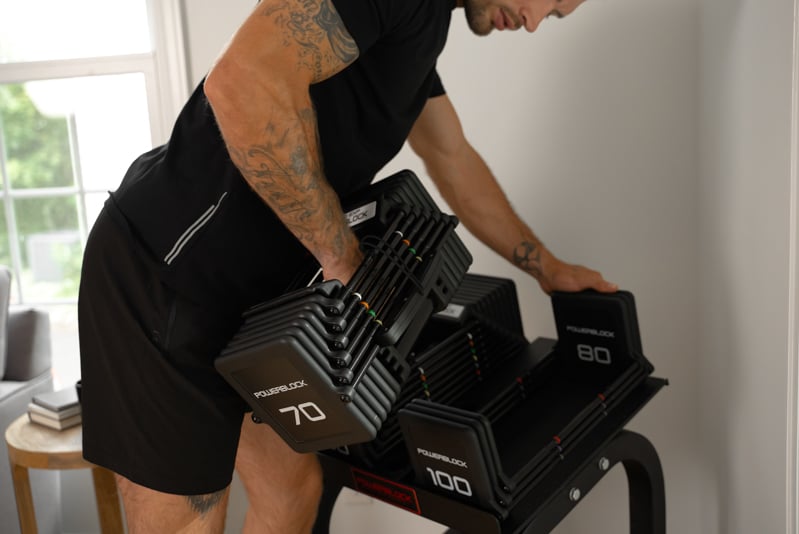
Progress in smaller steps. Adjustable dumbbells with 2.5-pound increments, like the PowerBlock Pro 50, let you increase resistance gradually instead of jumping straight to a heavier pair.
For home lifters, PowerBlock Adjustable Dumbbells make it possible to move between exercises and resistance levels without filling your workout space with multiple pairs of weights.

The 7 Best Dumbbell Biceps Exercises
These exercises offer different ways to train the biceps and brachialis. Focus on controlled reps and a full, comfortable range of motion rather than chasing the heaviest dumbbells you can lift.
1. Standing Dumbbell Curl
Targets: Both heads of the biceps brachii
The standing dumbbell curl is a foundational exercise for building biceps strength and size. It lets you train both arms at once while rotating your palms upward during each rep.
How to do it:
-
Stand tall with a dumbbell in each hand, arms extended, and palms facing your body.
-
Keep your elbows close to your sides as you curl the weights upward.
-
Rotate your palms forward and upward as you lift.
-
Squeeze your biceps near the top, then lower the dumbbells under control.
Sets and reps: 3 sets of 8–12 reps.
Common mistake: Swinging your torso to lift the weight. If you need momentum to finish a rep, use lighter dumbbells.

2. Incline Dumbbell Curl
Targets: Both biceps heads, with an emphasis on training the biceps in a lengthened position
The incline curl places your upper arms behind your torso, creating a greater stretch at the bottom than a standard standing curl. It's a useful variation for adding a different stimulus to your routine.
How to do it:
-
Set an adjustable bench to a moderate incline and sit back with a dumbbell in each hand.
-
Let your arms hang naturally, with your elbows slightly behind your torso.
-
Curl the weights without letting your upper arms drift forward.
-
Lower slowly until your arms return to a comfortable, nearly straight position.
Sets and reps: 2–3 sets of 10–12 reps.
Common mistake: Moving your elbows forward to finish the curl. Keep your upper arms steady, behind the body, and reduce the weight if necessary.

3. Hammer Curl
Targets: Brachialis, brachioradialis, and biceps brachii
Hammer curls are one of the best additions to a basic biceps routine because they use a neutral grip. They train the elbow flexors while placing less emphasis on turning the palms upward.
How to do it:
-
Stand with dumbbells at your sides and palms facing each other.
-
Keep your wrists straight and elbows close to your torso.
-
Curl the weights toward your shoulders without rotating your palms.
-
Lower slowly to the starting position.
Sets and reps: 3 sets of 10–12 reps.
Common mistake: Letting your wrists bend or your elbows swing forward. Keep the movement controlled from start to finish.

4. Concentration Curl
Targets: Biceps brachii, with an emphasis on controlled contraction
Concentration curls support strict technique by bracing your upper arm against your inner thigh. That makes it harder to use your back or shoulders to swing the weight.
How to do it:
-
Sit on a bench with your feet planted and hold one dumbbell.
-
Brace the back of your upper arm against your inner thigh.
-
Curl the dumbbell toward your shoulder while keeping your upper arm still.
-
Squeeze at the top, then lower slowly.
Sets and reps: 2–3 sets of 10–12 reps per arm.
Common mistake: Lifting your elbow away from your thigh to move the weight. Keep the upper arm braced and use a load you can control.

5. Preacher or Spider Curl
Targets: Biceps brachii, with strict positioning to limit momentum
Both variations help you keep your upper arms in front of your body. Preacher curls use the angled pad of a preacher bench, while spider curls are performed chest-down on an incline bench.
How to do it:
-
For a preacher curl, brace your upper arm against the pad. For a spider curl, lie chest-down on an incline bench with your arms hanging toward the floor.
-
Hold a dumbbell in each hand or work one arm at a time.
-
Curl without lifting your upper arms away from their supported position.
-
Lower under control, avoiding a forceful lockout at the bottom.
Sets and reps: 2–3 sets of 10–12 reps.
Common mistake: Bouncing out of the bottom position. Keep the movement smooth, especially near full elbow extension.
6. Cross-Body Hammer Curl
Targets: Brachialis, brachioradialis, and biceps brachii
This variation uses the same neutral grip as a hammer curl, but you bring the dumbbell across your body toward the opposite shoulder. It's another practical way to train the muscles that bend your elbow.
How to do it:
-
Stand with a dumbbell in each hand and palms facing inward.
-
Curl your right dumbbell toward your left shoulder without twisting your torso.
-
Lower it slowly, then repeat on the opposite side.
-
Keep your shoulders relaxed throughout the set.
Sets and reps: 2–3 sets of 10–12 reps per arm.
Common mistake: Rotating your whole body to move the dumbbell. Keep your torso still and let your arm do the work.
7. Zottman Curl
Targets: Biceps brachii, brachialis, and forearm muscles
The Zottman curl combines a palms-up curl with a palms-down lowering phase. It adds forearm work to a familiar biceps movement, making it a useful option when you want to train several elbow and forearm muscles in one exercise.
How to do it:
-
Stand with dumbbells at your sides and palms facing forward.
-
Curl both dumbbells upward with your palms facing up.
-
At the top, rotate your palms to face down.
-
Lower the weights slowly, then rotate your palms back up before the next rep.
Sets and reps: 2 sets of 10–12 reps.
Common mistake: Dropping the weights quickly during the lowering phase. The controlled descent is a key part of this exercise, so choose a weight you can manage.

Your Complete Dumbbell Biceps Workout
You don't need all seven exercises in one session. This workout combines a standard curl, a lengthened-position curl, and two neutral-grip movements to cover the main elbow flexors without excessive overlap.
|
Exercise |
Sets |
Reps |
Rest |
|
Standing dumbbell curl |
3 |
8–12 |
60–90 sec |
|
Incline dumbbell curl |
3 |
10–12 |
60–90 sec |
|
Hammer curl |
3 |
10–12 |
60–90 sec |
|
Concentration curl |
2 |
10–12 per arm |
45–60 sec |
Choose a weight that makes the last few reps challenging while allowing you to maintain good form. You don't need to reach complete muscular failure on every set. When you're new to this routine, start with fewer sets and build up as your recovery improves.

How to Program Your Biceps Training
How Often Should You Train Biceps?
For most home lifters, training biceps once or twice per week is a practical starting point. You can schedule a dedicated arm day or pair biceps work with a back workout, since many rowing and pulling exercises already involve the elbow flexors.
If you train biceps twice per week, spread your sessions out and account for the work your arms do during other pulling exercises. More sessions aren't automatically better if your total workload becomes too difficult to recover from.
For a balanced arm day, pair this routine with The Best Tricep Workouts With Dumbbells. Biceps train the front of your upper arm, while triceps train the back.
How to Make Your Biceps Grow Stronger
Progressive overload means gradually increasing the challenge your muscles face as you get stronger. You can do this by adding reps, increasing resistance, or improving your control and range of motion.
Start by recording the weight and reps you complete for each exercise. Once you can reach the top of your target rep range with good form across all sets, consider increasing the weight slightly.
This is where adjustable dumbbells can help. Some PowerBlock Adjustable Dumbbells offer 2.5-pound increments, making it easier to progress in smaller steps. Check your specific model's weight range and increments before increasing the load.
Small jumps are especially useful when a larger increase would force you to shorten your reps or swing the weights. The goal is steady progress, not lifting heavier at the expense of good technique.

Common Biceps Training Mistakes to Avoid
-
Swinging the weights. Using your hips or back to start a curl reduces control. Lower the weight and keep your torso steady.
-
Cutting reps short. Avoid stopping well before the bottom or rushing past the top. Use the fullest comfortable range you can control.
-
Skipping grip variations. Standing curls are useful, but adding incline and neutral-grip variations helps you train the elbow flexors in different positions.
-
Going too heavy. If your elbows drift, wrists bend, or shoulders take over, the load may be too much for strict curls.
-
Changing your routine too often. Stick with a manageable plan long enough to track progress. You don't need a new exercise every week.
Frequently Asked Questions
What are 7-7-7 bicep curls?
7-7-7 curls, or 21 method, are a curl variation that divides one extended set into three groups of seven reps: seven reps through the bottom half of the movement, seven through the top half, and seven full-range reps. The exact order can vary by trainer, so follow the version you're using. The method can add training volume, but it's not required to build muscle.
What are the top three biceps exercises?
A useful starting trio is the standing dumbbell curl, incline dumbbell curl, and hammer curl. Together, they train the biceps through different arm positions and add neutral-grip work for the brachialis and other elbow flexors.
Which dumbbell is best for biceps?
The best dumbbell is one that lets you use good form and progress over time. For home training, adjustable dumbbells offer several resistance levels in one compact set. Choose a weight range that suits your current strength and leaves room to progress.
Can you build biceps with just dumbbells?
Yes. Dumbbells provide enough resistance and exercise variety to build biceps and brachialis strength and size. Use a consistent routine, train with challenging but controlled reps, and gradually increase the difficulty as you improve.
Build Better Biceps, One Rep at a Time
Bigger arms don't require endless curls or the heaviest dumbbells in the room. They require a plan that trains the biceps from different positions, includes neutral-grip work for the brachialis, and gives you a way to progress over time.
Start with the four-exercise workout above, track your reps, and focus on clean technique. With consistent training and the right resistance, a pair of PowerBlock Adjustable Dumbbells can give you the flexibility to keep building strength at home.
Train with purpose. Progress with control. Let the results follow.