

Most apartment workout articles give you the same advice: skip the weights, grab some resistance bands, and keep things “low impact.”
That misses the point.
The real question isn't, “Can I work out at home?” It's, “Can I run a real strength program without noise complaints, floor damage, or losing my security deposit?”
Yes. You can.
You don't need a garage, a power rack, or a room full of equipment to build muscle and get stronger. You do need to think differently about how you train, what you put on the floor, and what equipment you bring into your apartment.
Here's how to build an apartment gym that actually works — followed by a three-day strength program you can use right away.

1. Most “Quiet” Floor Mats Don't Block the Sound That Actually Matters
A dumbbell hitting the floor creates more than one kind of noise.
There's the sharp thump you hear in the room. Then there's the deeper sound impact that can travel through the floor structure into the apartment below.
That's where things get tricky.
You may see flooring products advertised with a strong Impact Insulation Class (IIC) rating. But conventional IIC testing does not cover low-frequency sounds below 100 Hz. ASTM specifically notes that these low-frequency sounds can occur in lightweight floor systems and are not addressed by the traditional IIC rating. ASTM has since developed a separate low-frequency impact rating system for this reason.
In other words, a mat can have a good published rating and still not solve every type of impact noise your downstairs neighbor might hear.
So what should an apartment lifter do?
Start with more material between the weight and the floor. A thicker rubber surface can provide more mass and cushioning than a thin exercise mat. If you're installing a dedicated rubber floor, 12 mm (about ½ inch) is a reasonable minimum starting point.
But here's the bigger lesson:
The best way to reduce impact noise is to avoid creating the impact in the first place.
That's much more important than buying the thickest mat you can find.

2. A Slow Eccentric Is an Apartment Lifter's Secret Weapon
Here's the basic physics: the harder a weight hits the floor, the bigger the impact.
Set a dumbbell down under control, and you transfer far less impact into the floor than if you let it fall.
The good news is that controlling the weight isn't just a noise-reduction trick. It's also a legitimate training technique.
Research on resistance-training tempo suggests that slower eccentric phases, the lowering portion of a rep, can increase time under tension and provide an effective stimulus for muscle growth. The evidence does not show that extremely slow lifting is always better, though. A combination of a controlled eccentric and a more purposeful concentric movement appears to be a better general approach.
For apartment training, try a 2-1-3-0 tempo:
-
2 seconds up
-
1 second pause
-
3 seconds down
-
0 seconds resting at the bottom
That gives you a controlled six-second rep without turning every exercise into slow-motion training.
Some examples this works well for:
-
Dumbbell rows
-
Dumbbell bench press
-
Shoulder press
-
Romanian deadlifts
-
Curls
-
Lateral raises
Avoid trying to apply this method to movements that depend on explosive speed. Olympic lifts, snatches, jumps, and other power exercises are poor choices for an apartment because you can't simply slow them down without changing the exercise.
If your goal is competitive powerlifting or explosive power development, an apartment may eventually become limiting.
But if your goal is building muscle, getting stronger, and staying consistent, controlled dumbbell training can take you a very long way.

3. The Tenant Right Most Lifters Don't Know About
You've probably heard the phrase “quiet enjoyment.”
In landlord-tenant law, quiet enjoyment generally refers to a tenant's right to use and occupy their home without unreasonable interference. The exact rules and remedies vary by state and local law, so it isn't a universal “right to make noise” or a guarantee that your workouts are permitted.
And that's important.
Your downstairs neighbor has a right to reasonable peace in their home. You also have a right to use your apartment normally under the terms of your lease.
The dividing line is usually reasonableness: the lease, building rules, local noise ordinances, time of day, and the level and duration of the noise can all matter.
So don't assume that “it's before 10 p.m.” means anything goes.
Dropping weights, making repeated impact noise during posted quiet hours, or ignoring complaints is very different from doing controlled dumbbell exercises during the day.
Read your lease first. If your building has specific rules about exercise equipment, flooring, or noise, those rules matter more than a generic internet guideline.

4. Time Your Workouts to Background Noise
Most apartment-gym advice says, “Don't work out during quiet hours.”
That's good advice, but there's a smarter way to think about it:
Work out when your building already has some background noise.
Your dumbbell set doesn't exist in a vacuum. HVAC systems, traffic, doors, conversations, televisions, and normal daytime activity all create background sound.
That doesn't make noisy workouts acceptable. It simply means a controlled set of dumbbell presses is less likely to stand out at 5 p.m. than it is in a completely quiet building late at night.
As a practical starting point:
Best: 4–7 p.m.
People are coming home, HVAC systems are running, and normal building activity is higher.
Good: 9–11 a.m.
It's daytime, although your building's schedule may vary.
Use caution: 7–9 p.m.
Still reasonable in many buildings, but activity may be winding down.
Avoid when possible: before 8 a.m., after 9 p.m., and weekend mornings.
These aren't universal legal quiet hours. Apartment rules and local ordinances vary, and many properties use quiet-hour periods beginning around 10 p.m.
Think of these as noise-management guidelines, not legal rules.

5. Will Your Apartment Floor Hold a Home Gym?
You've probably seen the number 40 pounds per square foot online.
That number comes from residential building design standards. For example, the International Residential Code lists a 40 psf minimum uniformly distributed live load for areas other than sleeping areas.
But there's an important catch:
40 psf is not a universal “your floor can hold 40 pounds on every square foot” guarantee.
It's a design value for uniformly distributed loads. A heavy object sitting on a tiny footprint creates a different loading situation, and actual buildings vary by construction, age, location, and code requirements.
That's why you shouldn't use the 40 psf number by itself to decide whether a large home gym is safe.
For most apartment lifters, a compact setup with adjustable dumbbells, an adjustable bench, an exercise mat, and similar equipment is far less concerning than bringing in a huge rack, hundreds of pounds of plates, and a lifting platform.
If you're planning a large or unusually heavy setup, ask your landlord or building manager first.
And don't forget about the floor's finish.
Rubber can permanently discolor some vinyl floors. Rubber- and latex-backed mats can cause permanent staining because compounds in the rubber can react with vinyl flooring.
So before putting a rubber gym mat directly on vinyl or another sensitive surface, check your flooring manufacturer's instructions, if possible.
That's one small step that can save you from a very expensive move-out surprise.

6. Why the Type of Dumbbell Matters in an Apartment
Not all adjustable dumbbells are equally apartment-friendly.
Traditional spinlock dumbbells use plates that load onto a handle and are secured with collars. Changing weights can mean handling multiple loose pieces of metal.
Fixed dumbbells have the opposite problem: they're simple, but you need a separate pair for every weight. That gets expensive and takes up a huge amount of space.
Some selectorized adjustable dumbbells use a cradle to hold the unused plates. Depending on the design and movement, you may hear plates or components moving during a set.
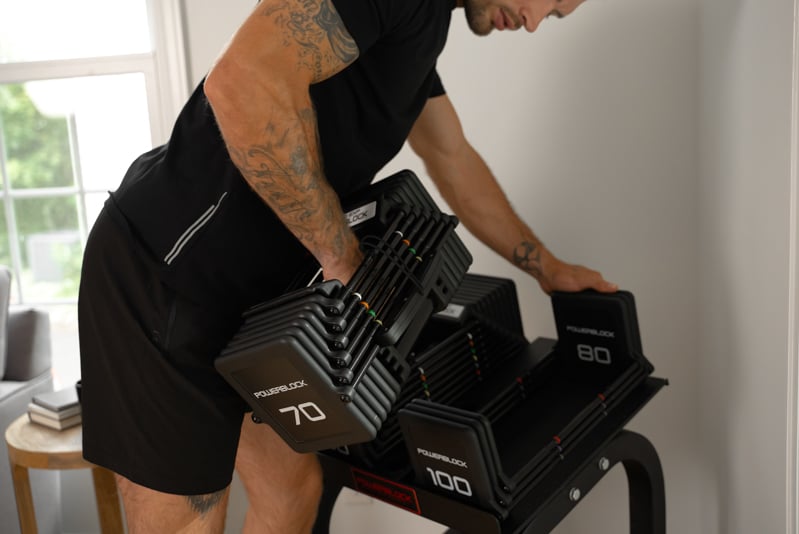
PowerBlock takes a different approach.
The weight plates are nested into a compact dumbbell structure, and a selector pin determines how much weight the handle picks up. The Pro 100 EXP uses urethane-coated weight plates and can expand from 5–40 pounds per dumbbell to 100 pounds per dumbbell with additional stages.
That matters in an apartment because compactness and controlled contact matter.
The Pro 100 EXP’s urethane plates are also designed to be quieter than exposed steel during contact.
No adjustable dumbbell should be treated as a weight you can freely drop. The goal is to train in a way that keeps the dumbbell under control from the first rep to the last.

7. The Equipment Setup That Actually Fits
An apartment gym should pass four tests:
-
Quiet
-
Compact
-
Lease-friendly
-
Able to grow with you
Every piece of equipment should earn its floor space.
Tier 1: The essentials
For most apartment lifters, start with:
-
Exercise mat
-
Folding or adjustable bench
That's enough to train your entire body.
Tier 2: Add more options
Once you have the basics, add:
-
Resistance bands
These give you more exercise options without filling the room with equipment.
Tier 3: Upgrade the setup
The biggest upgrade is organization.
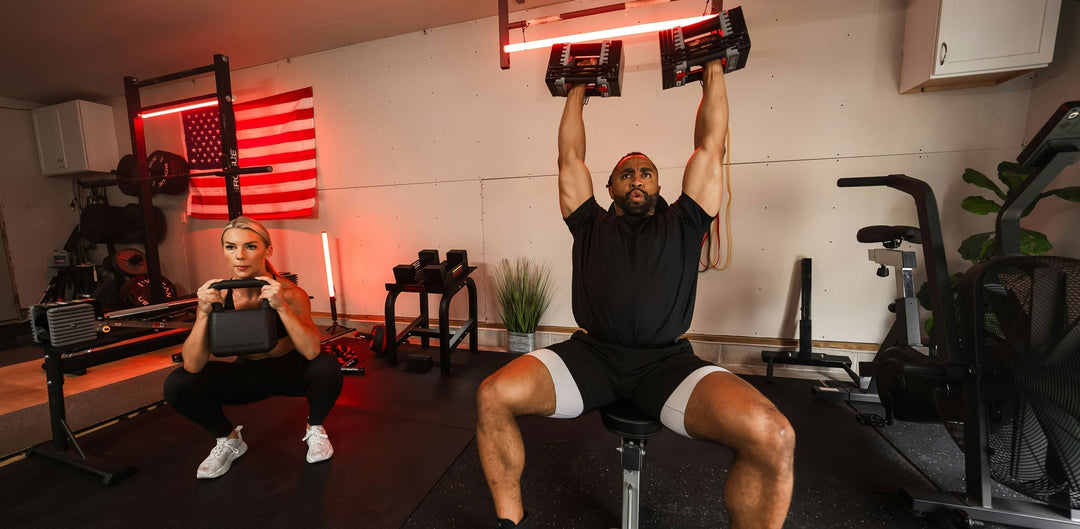
A dedicated dumbbell stand keeps your weights off the floor and makes changing exercises easier. Now if you choose PowerBlock’s Adjustable Dumbbells, Kettlebells, and Bench, you can add attachments such as a pull-up bar or dip station. This can expand what you can do without requiring a full gym.
For PowerBlock users, the right model depends on how much weight you actually need.
Sport 24: A compact option for lighter training, smaller spaces, and people who don't need heavy dumbbells. Adjusting from 3-24 lbs.
Pro 50: A compact, but bigger set than the Sport 24, with urethane plates that will help keep your lifts quieter. Adjusting from 5-50 lbs.
Elite USA 90: A strong middle ground for most apartment lifters who want an adjustable system that can grow. Stage 1 of the Elite USA 90 adjusts from 5-50 lbs, and you can purchase the stage 2 and 3 expansion kits to bring your dumbbell's weight capacity to 70 and 90 lbs, respectively.
Pro 100 EXP: The heavy-duty option for serious lifters who need up to 100 pounds per hand. It expands in stages rather than requiring you to buy the full weight range immediately.
The goal isn't to build the biggest apartment gym possible.
It's to build the smallest gym that can handle your goals.

The 3-Day Apartment Strength Program
Here's where the setup comes together.
Train three days per week for about 45 minutes. Use the controlled 2-1-3-0 tempo on most exercises, especially the lowering phase.
The research doesn't support the idea that everyone should lift extremely slowly, so don't turn every rep into a five-minute event. The goal here is controlled movement, not artificially slow movement.
Day 1 — Push
|
Exercise |
Sets |
Reps |
|
Dumbbell Bench Press |
4 |
8–12 |
|
Seated Dumbbell Shoulder Press |
4 |
8–12 |
|
Dumbbell Triceps Extension |
4 |
8–12 |
|
Dumbbell Lateral Raise |
4 |
10–15 |
Lower the weight under control. Finish each set by placing the dumbbells down deliberately.
Day 2 — Lower
|
Exercise |
Sets |
Reps |
|
Goblet Squat |
4 |
10–15 |
|
Dumbbell Romanian Deadlift |
4 |
10–15 |
|
Walking or Reverse Lunge |
4 |
10–15 |
|
Single-Leg Calf Raise |
4 |
10–15 |
If you don't have enough room to walk, use reverse lunges in place.
Day 3 — Pull + Core
|
Exercise |
Sets |
Reps |
|
Single-Arm Dumbbell Row |
4 |
10–12 |
|
Chest Supported Row |
4 |
10–12 |
|
Band Face Pull |
4 |
10–15 |
|
Biceps Curl |
4 |
30–60 sec. |
Throw in a few ab exercises every day, and you have yourself a full workout program.
How to Progress
Start with a weight you can control for the lower end of the rep range.
Once you can complete all your sets at the top of the range with good form, increase the weight slightly and work back up.
You don't need to chase maximum weights every workout.
In an apartment, control is part of your progression strategy.
Every exercise above can be performed with little or no impact noise when you control the eccentric and carefully return the weights to the floor, bench, or rack.

The 90-Second Neighbor Conversation That Can Prevent Complaints
Here's something almost no apartment workout guide tells you to do:
Introduce yourself to the neighbor below you.
Before setting up your gym, knock on the door.
Try something like:
“Hey, I'm setting up a small home gym in [room]. I'm using adjustable dumbbells only — no dropped weights and no jumping. I'll mostly be lifting between [time] and [time]. If you ever hear anything that bothers you, please come tell me directly, and I'll adjust.”
It takes about 90 seconds.
It also gives your neighbor a direct way to tell you about a problem before it becomes a complaint to the landlord.
Don't promise that they'll never hear anything. Instead, make it clear that you're trying to be considerate and that you're willing to adjust.
That's a much better relationship to have than discovering each other through a noise complaint.
The Bottom Line
You don't need to give up strength training because you live in an apartment.
You need to eliminate unnecessary impact.
That means controlling your reps, choosing compact equipment, protecting the floor surface, respecting your lease and building rules, and choosing workout times carefully.
A thick mat can help, but it isn't magic. A 40 psf building-code number doesn't automatically approve a home gym. And “quiet hours” aren't the only thing that matters.
The biggest difference comes from how you train.
Control the dumbbells. Don't drop them. Keep explosive movements out of the apartment. Choose equipment that doesn't take over the room.
Do that, and a pair of adjustable dumbbells can give you a surprisingly complete strength training gym without turning your apartment into a commercial weight room.
The right equipment makes all of this easier. Pair PowerBlock Adjustable Dumbbells with the PowerBench 2.0, then add a pull-up, dip, and ab attachments when you want more exercise options. The result is a compact setup that can grow with you without filling your apartment with equipment.

FAQ
Can you really build muscle in an apartment?
Yes. You can build muscle with adjustable dumbbells, a bench, and a well-designed resistance-training program. Training tempo, progressive overload, sufficient effort, and consistency matter more than having a commercial gym.
What's the quietest weight equipment for apartments?
Adjustable dumbbells are among the most practical options because they let you replace many fixed-weight pairs with one compact set. The biggest noise reduction, however, comes from controlling the weights and never dropping them.
Will my apartment floor hold a home gym?
Many residential floors are designed for substantial live loads. Still, building-code numbers such as 40 psf refer to uniformly distributed loads and are not a guarantee for every apartment or equipment setup. If you're planning a large, heavy gym or equipment with concentrated loads, ask your landlord or building manager first.
Are adjustable dumbbells good for apartments?
Yes. They take up much less space than a full set of fixed dumbbells and can provide enough weight for a complete strength program. Models that minimize loose plates and unnecessary contact are especially useful when noise and storage space matter.
Can I do deadlifts in an apartment?
You can do controlled dumbbell Romanian deadlifts, but traditional barbell deadlifts are different. Repeatedly lowering or dropping a loaded barbell creates more impact, takes more floor space, and is harder to control quietly.
Should I tell my landlord I have a home gym?
Check your lease and building rules first. If they restrict exercise equipment, excessive noise, floor modifications, or unusually heavy equipment, ask the landlord or property manager before setting anything up.