

If you train at home, you may be missing one of the biggest pieces of a commercial gym: the cable machine.
The lat pulldown and cable row are popular for a reason. They make it easy to train your back through different pulling angles and keep tension on the muscles throughout the movement. But what if you only have dumbbells?
Can you still build a strong, muscular back?
Yes. But there is one important catch: you need to understand what dumbbells can do well, and where they have a gap.
A complete dumbbell back workout should include rows for your upper and middle back, hip-hinge movements for your lower back and posterior chain, rear-delt work, and a movement that gives your lats a different challenge than pull-downs.
That last part is where many dumbbell back exercises fall short.
In this guide, we'll show you how to build a complete back workout with dumbbells at home, how to address the missing vertical pull, and how to put it all together into one simple workout.

What Muscles Are You Training on Back Day?
Your back is not one single muscle. It is a group of muscles that work together to pull, stabilize your spine, move your shoulders, and control your shoulder blades.
Understanding those muscles makes it easier to choose the best dumbbell exercises for back development.
Lats
The latissimus dorsi, or lats, are the large muscles that run along the sides of your back. Well-developed lats help create a V-shaped upper body.
Rows train the lats, but they are not the only muscles involved in rowing. That's why it's useful to include another movement that gives the lats a different stimulus.
Rhomboids and Mid-Traps
The rhomboids and middle trapezius help pull your shoulder blades together. Rows and reverse flys are useful ways to train these muscles.
Upper Traps
Your upper traps run from your neck toward your shoulders. They help move and stabilize the shoulder blades.
Shrugs are a simple way to train them directly. Just remember that your traps already get plenty of work from rows and other pulling movements, so you don't need to make shrugs the center of your workout.
Erector Spinae
The erector spinae are muscles along your spine that help keep your torso stable. They work hard during exercises such as Romanian deadlifts and other hip-hinge movements.
This matters because a complete back workout isn't just about your upper back. Your lower back and posterior chain need attention, too.

The Vertical Pull Gap
Here's the honest part about a dumbbell-only back workout:
Dumbbells cannot perfectly replicate a lat pulldown.
A lat pulldown gives you a true vertical pulling pattern. A dumbbell row is a horizontal pull. Both train the back, but they are not the same movement.
So if you don't have a cable machine or pull-up bar, what should you do?
The dumbbell pullover is one of the best options available. It allows you to train the lats through shoulder extension while lying on a bench, giving your back a stimulus that is different from a standard row. Research has found that the pullover can produce meaningful latissimus dorsi activity, although it should not be treated as a perfect replacement for a pulldown.
If you have a PowerBench 2.0, there is an even better solution. The PowerBench 2.0 Chin-Up Attachment turns the bench into a pull-up and chin-up station, giving you access to a true vertical pulling movement.
If you don't have that attachment, don't worry. A combination of pullovers and rows can still give your dumbbell-only program broad back coverage.

The Best Dumbbell Back Exercises
1. Bent-Over Dumbbell Row
Targets: Lats, rhomboids, traps, rear delts, erector spinae
The bent-over row is the foundation of most dumbbell back workouts. It lets you move a lot of weight while training several muscles at once.
How to do it (step-by-step):
-
Stand with your feet about hip-width apart.
-
Hold a dumbbell in each hand with your arms hanging straight down.
-
Take a breath and brace your core like you're about to be lightly punched in the stomach.
-
Push your hips back and bend your knees slightly.
-
Keep your chest angled toward the floor and your back flat.
-
Let the dumbbells hang under your shoulders.
-
Pull the dumbbells up toward your sides by driving your elbows back.
-
Pause briefly at the top.
-
Lower the weights slowly under control.
-
Repeat for reps without standing fully upright between reps.
Try: 3 sets of 6–10 reps
Common mistake: Turning the exercise into a full-body swing. If your torso is bouncing to move the weight, the dumbbells are probably too heavy.

2. Single-Arm Dumbbell Row
Targets: Lats, rhomboids, traps, rear delts
The single-arm row is one of the best unilateral back exercises you can do with dumbbells. Training one side at a time lets you focus on each lat and upper-back muscle separately.
Place one hand on a bench for support and keep your torso stable. Pull the dumbbell toward your hip rather than straight toward your shoulder.
How to do it (step-by-step):
-
Place your left knee and left hand on a bench.
-
Keep your right foot planted on the floor for balance.
-
Hold a dumbbell in your right hand with your arm fully extended.
-
Keep your back flat and your neck neutral.
-
Pull the dumbbell toward your right hip (not your shoulder).
-
Squeeze your back at the top for a second.
-
Lower the dumbbell slowly until your arm is fully extended.
-
Complete all reps, then switch sides.
Try: 3 sets of 8–12 reps per side.
Common mistake: Twisting your torso to get the weight higher. Keep your shoulders and hips as square as possible.

3. Romanian Deadlift
Targets: Erector spinae, glutes, hamstrings, traps
The Romanian deadlift, or RDL, is not an upper-back exercise, but it belongs in a complete back workout.
Why? Your back has to work hard to keep your spine stable while your hips and hamstrings handle the movement.
How to do it (step-by-step):
-
Stand tall holding dumbbells in front of your thighs.
-
Keep your feet about hip-width apart.
-
Slightly bend your knees and keep them fixed.
-
Push your hips straight back like you're closing a car door with your butt.
-
Lower the dumbbells down your legs.
-
Keep your back flat and chest proud.
-
Stop when you feel a strong stretch in your hamstrings.
-
Drive your hips forward to return to standing.
Try: 3 sets of 6–10 reps.
Common mistake: Rounding your lower back. Keep your spine neutral and move from your hips.

4. Reverse Fly
Targets: Rear delts, rhomboids, mid-traps
The rear delts and smaller upper-back muscles are easy to ignore. Don't. Due to their small size, you don’t need a large range of motion.
How to do it (step-by-step):
-
Hinge at your hips until your torso is almost parallel to the floor.
-
Let the dumbbells hang straight down.
-
Keep a slight bend in your elbows.
-
Raise both arms out to the sides in a wide arc.
-
Think about squeezing your shoulder blades together.
-
Pause briefly at the top.
-
Lower the weights slowly back to the start.
Try: 2–3 sets of 10–15 reps.
Common mistake: Using heavy dumbbells and turning the exercise into a swing. Reverse flys usually work better with lighter weights and controlled reps.

5. Dumbbell Pullover
Targets: Lats, with help from the chest and other shoulder muscles
The pullover is the key exercise for filling the vertical-pull gap in a dumbbell-only program.
Lie across or along a bench with one dumbbell held above your chest. Keep a slight bend in your elbows. Slowly lower the dumbbell behind your head, then pull it back over your chest.
Focus on controlling the movement rather than chasing maximum weight.
How to do it (step-by-step):
-
Lie on a flat bench with your upper back supported.
-
Hold one dumbbell with both hands above your chest.
-
Keep a slight bend in your elbows and lock them in place.
-
Slowly lower the dumbbell behind your head in an arc.
-
Go only as far as your shoulders comfortably allow.
-
Pull the dumbbell back over your chest using your lats.
-
Stop when the weight is directly above your chest again.
-
Repeat with control.
Try: 2–3 sets of 10–15 reps.
Common mistake: Turning it into a triceps exercise by bending and straightening your elbows too much.

Remember: a pullover is not identical to a lat pulldown. It is simply one of the most useful dumbbell-only options for adding a different lat-focused movement.
6. Chest-Supported Dumbbell Row
Targets: Lats, rhomboids, mid-traps, rear delts
If your lower back gets tired before your upper back during rows, try a chest-supported row.
Set an adjustable bench to an incline and lie face down with a dumbbell in each hand. Pull the weights toward your ribs while keeping your chest against the bench.
Because the bench supports your torso, your lower back has less work to do. That can help you focus on your upper back.
How to do it (step-by-step):
-
Set an adjustable bench to a 30–45 degree incline.
-
Lie face down with your chest on the bench.
-
Let your arms hang straight down holding dumbbells.
-
Brace your core lightly against the bench.
-
Pull the dumbbells toward your lower ribs.
-
Squeeze your shoulder blades together at the top.
-
Lower the weights slowly until arms are fully extended.
-
Repeat without lifting your chest off the bench.
Try: 3 sets of 8–12 reps.
Common mistake: Shrugging your shoulders toward your ears. Keep your shoulders controlled as you row.

7. Dumbbell Shrug
Targets: Upper traps
Shrugs are simple: stand tall with dumbbells at your sides and raise your shoulders toward your ears. Pause briefly at the top, then lower them under control.
How to do it (step-by-step):
-
Stand tall holding dumbbells at your sides.
-
Keep your arms straight and relaxed.
-
Lift your shoulders straight up toward your ears.
-
Hold the top position for 1 second.
-
Lower your shoulders slowly back down.
-
Repeat without rolling your shoulders.
Try: 2–3 sets of 10–15 reps.
Common mistake: Rolling your shoulders in circles. A straight up-and-down movement is all you need.

Your Complete Dumbbell Back Workout
Here's how to combine the exercises into a single back workout at home with dumbbells.
|
Exercise |
Sets |
Reps |
Rest |
|
Dumbbell Pullover |
3 |
12-15 |
60-90 seconds |
|
Romanian Deadlift |
3 |
6-10 |
2 min. |
|
Bent Over Row or Single Arm Row |
3 |
6-10 |
2 min |
|
Chest Supported Row |
3 |
8-12 |
2 min |
|
Reverse Fly |
3 |
12-15 |
60-90 seconds |
|
Dumbbell Shrugs |
3 |
12-15 |
60-90 seconds |
You don't need to use every exercise every time. If you're newer to strength training, start with fewer sets and focus on learning the movements.
The pullover is intentionally at the start of your workout to warm up your shoulders, the back muscles we’ve discussed, and your abs. Your heavy rows and RDLs should get your biggest effort, and when it comes to back training, you want to start with your strongest muscles and work up towards the weaker ones.
If you have the PowerBench 2.0 and the PowerBench 2.0 Chin-Up Attachment, you can also add chin-ups or pull-ups. That gives your home gym a true vertical pull and is the simplest way to close the gap left by a missing lat pulldown.
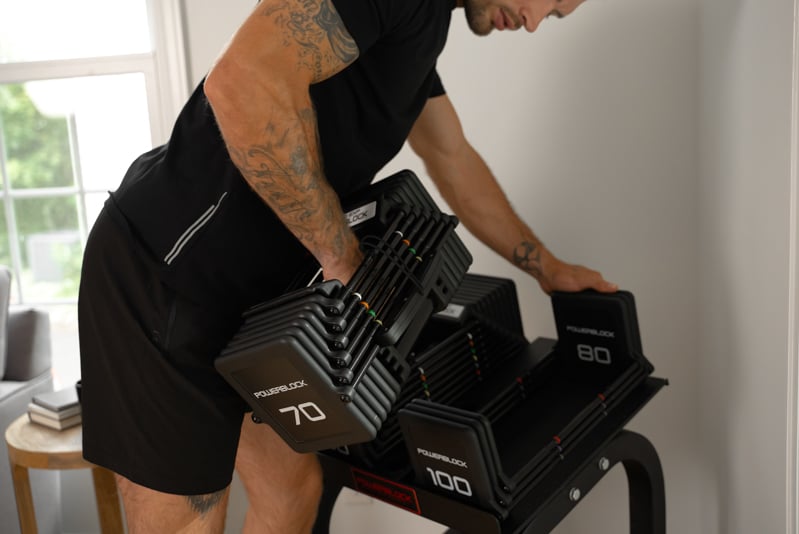
For dumbbells, the PowerBlock Pro 50 is a practical option for many home lifters, with adjustments from 5 to 50 pounds. If you need more loading capacity for heavy rows and RDLs, the Pro 100 EXP can expand from 5 to 100 pounds per dumbbell with its expansion stages.

How to Program Your Back Training
For most lifters, training the back one or two times per week can work well.
If you're training your back once per week, use the full workout above.
If you're training it twice, you don't need to repeat the same session. You could make one day more focused on heavy rows and RDLs and make the second day more focused on single-arm rows, chest-supported rows, reverse flys, and pullovers.
You can also use this workout alongside PowerBlock's Best Pull Day Workout: Build a Stronger Back and Bigger Arms article. The two approaches are complementary. A pull day can include your back work along with biceps and other pulling muscles.
Don't Forget Progressive Overload
Your back needs a reason to adapt.
With adjustable dumbbells, progression can be simple. Start by choosing a weight that lets you complete your target reps with good form. When you can consistently reach the top of the rep range, increase the weight and build your reps back up.
For example:
Week 1: 60 pounds × 8 reps
Week 2: 60 pounds × 9 reps
Week 3: 60 pounds × 10 reps
Week 4: 65 pounds × 8 reps
The exact numbers will depend on your strength level. The goal is simply to make the exercise gradually more challenging while keeping good technique.

Common Dumbbell Back Workout Mistakes
Using Too Much Biceps
Your biceps help during rows, but they shouldn't take over.
Think about driving your elbows toward your hips or ribs instead of pulling the dumbbells with your hands. This simple cue can help you focus more on your back.
Rounding Your Lower Back
This is especially important during bent-over rows and RDLs.
Keep your spine controlled and your movement coming from your hips when you're hinging. If you can't maintain your position, reduce the weight.
Skipping the Pullover
Rows are great, but rows alone don't solve the vertical-pull problem.
If you don't have a pull-up bar or lat pulldown, the pullover gives your dumbbell-only workout another way to challenge the lats.
Training Only Your Upper Back
Don't forget your erector spinae, rear delts, and posterior chain.
A strong back isn't just about having big lats. Your workout should train the muscles that help you pull, stabilize your spine, and control your shoulders.

Frequently Asked Questions
What is the best dumbbell back workout?
The best routine is one that covers multiple functions of the back. A strong starting point includes an RDL, bent-over row, single-arm row, reverse fly, pullover, and optional shrug. If you have a pull-up or chin-up attachment, add vertical pulling as well.
Can you build back muscle with just dumbbells?
Yes. Dumbbells can provide enough resistance for rows, RDLs, reverse flys, pullovers, and other movements that train the back. The key is consistent training, good technique, enough effort, and progressive overload.
What are the big 3 back exercises?
There isn't one official "big 3" for back training. For a dumbbell-only home gym, a useful three-movement combination is the bent-over row, Romanian deadlift, and dumbbell pullover. Together, they cover heavy rowing, posterior-chain work, and a different lat-focused movement.
What is the 4-2-1 dumbbell method?
The term "4-2-1" is used online for more than one training method, so be careful with the name. One popular version is a weekly schedule of four strength-training days, two cardio days, and one mobility day. Another version uses a 4-second lowering phase, a 2-second pause, and a 1-second lifting phase.
Neither is required for an effective dumbbell back workout. If your goal is building your back, focus first on good exercise selection, consistent training, and progressive overload.

Build Your Back Without the Cable Machine
You don't need a commercial gym to train your back well.
Dumbbells give you plenty of options for rows, hinges, rear-delt work, and trap training. The one limitation you need to understand is the missing vertical pull.
That's why the smartest dumbbell-only approach isn't to pretend a row is the same as a pulldown. Instead, build your workout around heavy rows and RDLs, add rear-delt and trap work, and use the dumbbell pullover to give your lats a different movement pattern.
If you want to take your home gym further, a PowerBench 2.0 with the Chin-Up Attachment adds true pull-ups and chin-ups to the setup.
Pair that with a set of PowerBlock Adjustable Dumbbells, such as the Pro 50 or expandable Pro 100 EXP, and you have a compact setup capable of handling far more than just back day.
The result is simple: a complete back workout without needing a cable machine.